

The Limits of Legislating Towards a Cruelty-Free Future
Emilie-Louise Feldberg
After banning animal-tested, and animal testing in relation to, cosmetics in 2023, Canada introduced a Bill in 2023 and a Strategy in 2025 designed to replace, reduce, and refine the use of vertebrate animals in toxicity testing. This article explores the extent to which these Canadian laws protect non-human animals against exploitation and questions whether persistent anthropocentric beliefs and practices render it nearly impossible for legislation to materially protect animal interests, bodies, and lives.
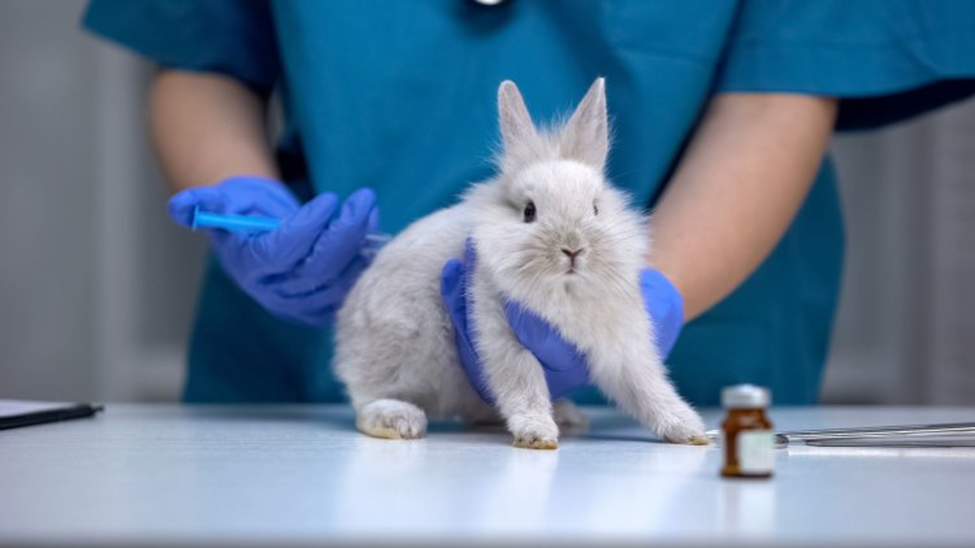
Before I’d learned the wonderful skill of tact, I almost lost a friendship at Sephora. I loved makeup as a teenager, but I also loved my dog and the robins nesting outside my bedroom window. Naturally, then, every product I used had to be completely cruelty-free. Policing myself, however, wasn’t enough, and so, one day in 2016, I asked my friend if she knew the blush she’d picked out had been tested on animals. She nodded sheepishly before presenting her defense: but it’s the perfect colour. We bickered back and forth as the till loomed ever closer and until my patience ran out, which is when I went for a (truly) low blow and appealed to the rhetorical strength of her beloved pet rabbit: is the “perfect colour” worth more than one thousand Frankies? She paled and went silent. I was both guilty and smug. An awkward twenty minutes later, we left the Chinook mall with matching, cruelty-free E.L.F. dupes and, miraculously, as friends.
This was before the Canadian government banned the manufacture and import of cosmetics tested on animals in 2023, exempting only products already on the market relying on existing animal testing data. [1] That same year, Canada introduced Bill S-5, amending the Environmental Protection Act with provisions “aimed at replacing, reducing or refining the use of vertebrate animals in toxicity testing.” [2] In July 2025, Canada introduced its Strategy to Replace, Reduce or refine Vertebrate Animal Testing under the Canadian Environmental Protection Act, 1999 (“Strategy”) which similarly aims to reduce and regulate animal testing to reduce distress caused to vertebrate animals, containing a more detailed, structured approach. [3] These developments raise an important question: could Canada’s legislation materially address and improve the marginalized position non-human animals occupy in society?
Animal testing is an uncomfortable conversation topic, but a nearly inevitable practice under an anthropocentric order. [4] A species that views itself as the pinnacle of evolution, so exceptional that its members have transcended kingdom animalia itself through reason, language, and culture, will not lack arguments to justify its domination. Law similarly functions to justify and maintain humankind’s “entitle[ment] to the privileges our current anthropocentric social, cultural, and economic order affords us.” [5] In Animals as Legal Beings: Contesting Anthropocentric Legal Orders, Maneesha Deckha explores how “dominant social mores” [6] reinforcing the inferiority of non-human animals become reflected in, and reinforced through contemporary legal orders premised on a narrow conception of personhood. Law therefore facilitates the violence committed against non-human animals by relegating them to the category of, and regulating them as, property. [7] As such, any “animal exploitation that is not wholly gratuitous,” [8] however unsavoury or downright monstrous, is permissible. I suggest that, despite their progressive aims, Bill S-5 and the Strategy cast a broad net for what will not be considered gratuitous or trivial treatment of animal bodies under Canadian law. The legislation reveals that non-human animal rights and protections are granted only to the extent that doing so does not threaten the anthropocentric hierarchy.
While Canada’s animal-tested cosmetics ban suggests beauty may be gratuitous, the rate at and the purposes for which animal tests are conducted in Canada suggests that science, knowledge, and ‘human progress’ are not. The Canadian Council on Animal Care (CCAC) estimates at least 3.7 million animals – comprising fish, mice, cattle, rats, birds, dogs, cats, rabbits, and more – were subjected to experiments in Canada in 2024, where 1.2 million tests caused moderate to severe distress or discomfort, and approximately 90 000 non-human animals experienced severe pain or death. [9] The actual number is undoubtedly higher: CCAC’s report only includes entities required to comply with its standards. [10] Proponents for animal testing often refer to it as a “necessary evil […] ultimately worth it for the greater good,” [11] referring to its generation of, for example, life-saving treatments; however, CCAC’s report reveals that many experiments serve mere “training or education” purposes. [12] Any high school graduate is no doubt familiar with the ‘necessary evils’ of training and education purposes: at 14, I was handed a scalpel and a frog’s corpse and taught that a non-human animal’s life’s value fell below that of even the least useful or informative scientific inquiry. CCAC’s report supports the contention that practices even tangentially related to scientific progress, medicine, or capital are neither trivial nor gratuitous. How could they be, when these are the very achievements invoked to justify human exceptionalism?
Canada’s new legislation perfectly captures this idea: despite the Strategy’s detailed framework, ministers are only required to introduce alternatives to animal testing insofar as these alternatives are “practicable” and “scientifically justified”; [13] this same language appears in Bill S-5. Internationally, animal testing practices and regulations arguably maintain “usefulness, efficiency, and convenience [as] overriding principles.” [14] Similarly, according to Bill S-5 and the Strategy, mere practicality can trump “the life-and-death import of the animal interest.” [15] The sky-high threshold for what consists of a gratuitous or trivial use of animal bodies becomes enshrined in law, and always at mankind’s discretion.
Furthermore, skepticism haunts the seriousness with which the government will prioritize and implement the Strategy’s aims.While Angela Fernandez, director of the Animal Law Program at the University of Toronto, welcomed the Strategy’s progressive objective of phasing out toxicity testing on animals by 2035, she notes its lack of corresponding concrete plans regarding funding or staffing allocation. [16] So far, available information appears limited to Health Canada’s claim that the “money to implement the strategy will come out of existing budgets.” [17] Good intentions and proposed strategies are insufficient substitutes for actual enforcement and positive action, and suggest a persistent hesitation to materially prioritize non-human animal interests over administrative efficiency.
Finally, both Bill S-5 and the Strategy are limited to toxicity testing, sometimes referred to as “the most harmful use of animals in Canadian science,” often falling into CCAC’s “most severe category of harm that animals can experience.” [18] Therefore, even considering Canada’s ban on animal-tested cosmetics and the recent progressive legislation, Canada continues to permit a great deal of non-human animal experimentation for a host of purposes. Consequently, much of the work remains in front of us, and progress could be further hindered by constitutional hurdles: animal experimentation falls, by and large, under provincial jurisdiction. [19]
To believe animal testing is permissible in any form, we necessarily start from the position that a human life is inherently more valuable than a non-human one. I prefer to start from here: every being wants its life as much as I want my own. From there, animal testing reveals itself, to borrow Gary Snyder’s words, as a “source of boundless bad luck for this society.” [20] Forging a liveable future for ourselves goes beyond curbing or containing environmental destruction – it involves envisioning a future where we live well with each other and where we can live with ourselves. It asks us to achieve more than what Bill S-5 and the Strategy achieve. Step one is easy: it involves looking for a Leaping Bunny Logo or visiting Cruelty Free Kitty’s list of cruelty-free companies. What comes next is harder. That’s where we question whether and why human knowledge, progress, and even life, warrant the use of an equal being’s body and singular existence as a mere means to self-serving ends.
Emilie-Louise is a 1L student in the Faculty of Law at McGill University. Originally from Calgary, Alberta, she specialized in the environmental humanities throughout her undergraduate degree, where she majored in English and Philosophy and wrote her honours thesis on black-billed magpies. She decided to become an advocate so that she might one day give back to the mountains, the chinooks, and the bobcats back home. A very special thank you to Victor for his guidance and to the MJSDL for giving students the opportunity to voice what often goes unsaid!
[1] Government of Canada, “Animal testing ban on cosmetics” (last modified 4 December 2023), online: <www.canada.ca/en/health-canada/services/cosmetics/animal-testing-ban.html>.
[2] Government of Canada, “Bill S-5, Strengthening Environmental Protection for a Healthier Canada Act - Summary of Amendments” (last modified 28 September 2023), online: <www.canada.ca/en/services/environment/pollution-waste-management/strengthening-canadian-environmental-protection-act-1999/bill-c-28-strengthening-environmental-protection-healthier-canada-act-summary-amendments.html#toc8> [Bill S-5].
[3] Government of Canada, “Strategy to replace, reduce, or refine vertebrate animal testing under the Canadian Environmental Protection Act, 1999 (CEPA)” (July 2025), online: <www.canada.ca/en/environment-climate-change/services/canadian-environmental-protection-act-registry/implementing-modernized-cepa/strategy-replace-reduce-refine-vertebrate-animal-testing.html> [Strategy].
[4] Donna Haraway, “Anthropocene, Capitalocene, Plantationocene, Cthulucene: Making Kin” (2015) 6:1 J Environmental Humanities 159 at 160.
[5] Maneesha Deckha, Animals as Legal Beings: Contesting Anthropocentric Legal Orders, (Toronto: University of Toronto, 2020) at 6.
[6] Ibid at 165.
[7] Ibid.
[8] Ibid at 42.
[9] Canadian Council on Animal Care, “CCAC Animal Data Report 2024” (2025) at 4, online (pdf): <ccac.ca/Documents/AUD/CCAC_Animal_Data_Report_2024.pdf>.
[10] Ibid at 9.
[11] Jessica Scott-Reid, “Opinion: Animal testing isn’t just cruel. It could be setting us back” (2025) Toronto Star, online: <www.thestar.com/opinion/contributors/animal-testing-isnt-just-cruel-it-could-be-setting-us-back/article_f7939696-1f3a-422a-9902-036b245ea994>.
[12] Canadian Council on Animal Care, supra note 10.
[13] Government of Canada, supra note 3.
[14] Giorgia Marino, “Animal Testing: A Still Necessary Evil?” (September 2025) Renewable Matter Magazine Number 50 – Animals (Insights), online: <www.renewablematter.eu/en/animal-testing-still-necessary-evil>.
[15] Deckha, supra note 5 at 42.
[16] Elizabeth Thompson, “Federal government adopts new strategy to reduce animal testing” (September 11, 2025) CBC News, online (article): <www.cbc.ca/news/politics/canada-animal-testing-strategy-1.7630546>.
[17] Ibid.
[18] Kaitlyn Mitchell, “Canada Releases Strategy to Reduce & Replace Animals in Toxicity Testing” (October 29, 2024) Animal Justice, online (blog): <animaljustice.ca/blog/canada-releases-strategy-toxicity-testing>.
[19] Canadian Council on Animal Care, “Animals Used in Science: Canadian Legislation and Policies” (2025-2026) online: <ccac.ca/en/animals-used-in-science/canadian-legislation-and-policies/>.
[20] Gary Snyder, “The Etiquette of Freedom” (1994) 81:1 Psychoanalytic Rev 57 at 71.