

AI is Doubly Unsustainable: Looking at How the Projected Environmental and Socioeconomic Harms of AI Could Converge in Canada’s Oldest City
Maddie Adams Alexander
This blog post examines how artificial intelligence is both environmentally and socially unsustainable. While AI has harmful consequences for an already jeopardized environment, making it ecologically unsustainable, AI also poses a threat to jobs in that it is projected to directly replace some jobs and to devalue human labour for certain tasks in coming years. This blog post also highlights the importance of developing strong regulations for the use of AI in workplaces and schools; regulation that goes beyond safety obligations and actively considers and anticipates impacts on human development. Looking at Saint John, New Brunswick, specifically, this blog post further explores how the environmental and social unsustainably of AI could interact in a region already facing generational poverty.
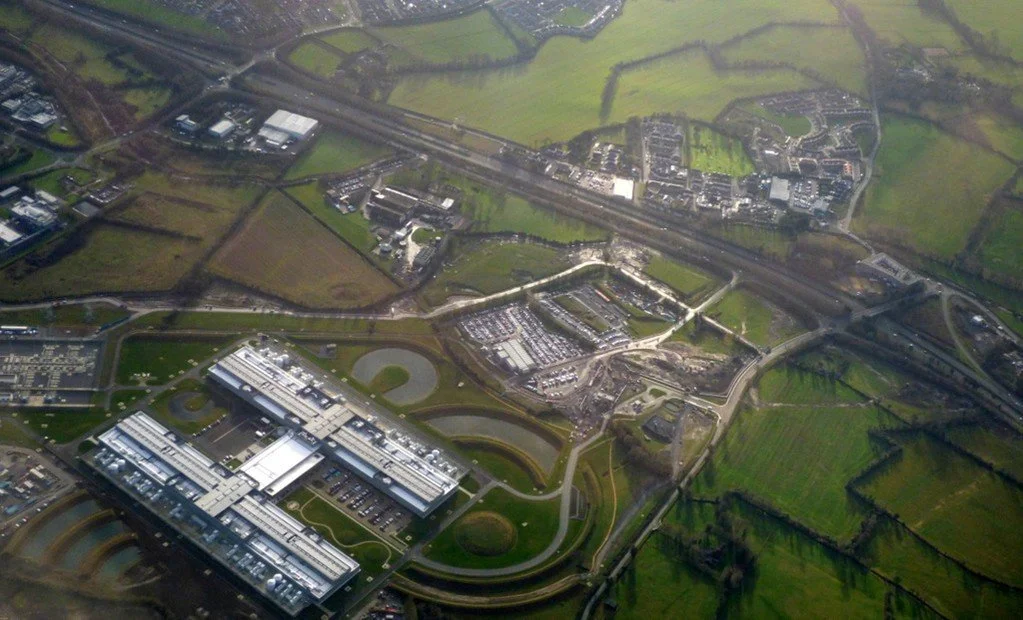
Image credit to Thomas Nugent
AI and the Environment
One of the greatest risks of widespread AI use and implementation is environmental harm. As AI rapidly expands, computing infrastructure necessarily expands with it.[1] This computing infrastructure, in the form of large data centres, drains enormous amounts of power and water.[2] The current rate of AI growth would result in up to 1,125 million cubic meters of water being drained per year by 2030.[3] To greater contextualize the severity of this threat, a UN report on January 20th of this year declared we have officially entered “the era of global water bankruptcy” and asked world leaders to work toward an “honest, science-based adaptation to a new reality”.[4]
While there are some ways to minimize these environmental impacts, such as choosing “optimal” locations for data centres, if decarbonization does not catch up to the demands of AI growth, emissions are at risk of increasing by 20%.[5] Even if grid decarbonization reaches its most ambitious targets, there would still be an estimated 11 million tons of residual emissions remaining that would have to be accounted for using other technologies, like wind and solar power, to reach net-zero.[6] This is why regulation for AI use and data centre infrastructure is critical right now, and why it necessitates community input.
AI and Socio-Economic Development
AI’s potential for greater efficiency and profit come at the cost of greater job displacement. The World Economic Forum speaks of AI’s potential to “unlock systemic productivity advances.”[7] When business executives and CEOs speak about AI, almost half of them (45%) believe increased profits to be a likely product of AI. Yet, more than half of them (54.3%) believe AI will also displace a large number of existing jobs, while only 12.2% of them believe AI will lead to higher wages.[8] This projected efficiency and revenue increase is directly a product of replacing human labor. When the possibilities of AI for “growth” are being discussed, we must ask; growth for who? If AI does lead to levels of productivity never before seen, the resulting profits are unlikely to be evenly distributed.[9]
How AI’s Doubly Harmful Impacts Could Impact Communities
Recent talks of data centre construction in the city of Saint John, New Brunswick, exemplify how the possible compounding environmental and socioeconomic harms of AI can exacerbate inequality and have disproportionate impacts on the communities that get sacrificed to data centre infrastructure. Co-founders from Calgary-based Beacon AI Centers and Texas-based Volta Grid visited Saint John in November of 2025 to discuss their data centre construction proposal with members of the Saint John community.[10] The plan is to build a data centre in Spruce Lake Industrial Park.[11] The proposal has been approved for expansion in July, even with great pushback from the community.[12] Over 100 community members attended a recent “townhall” with the co-founders, and almost none of them wanted the data centre project to move forward.[13]
Residents were promised that any expansions in that industrial park would be “non-emitting” projects, yet the data centre will be fueled by an on-site, natural-gas generating system.[14] One of the co-founders attempted to quell worries by telling the community that the project is committed to 98% emissions abatement.[15] However, non-emitting and emissions abatement are not interchangeable, and, as noted by Saint John Green Party Leader David Coon, every bit of carbon emissions makes the climate crisis worse.[16] The co-founders also claimed that the facility will consume “nearly zero water.”[17] The residents do not believe this claim.[18] The co-founders later explained that the data centre would utilize a “closed-loop system” that “needs liquid”; they could not say how much “liquid” that loop would use.[19]
Further, Saint John is a community that is already rife with poverty and lack of employment opportunities. The child poverty rate in Saint John in 2021 was 27.3%.[20] This was an increase of 2.1% since the prior year, and it is higher than both the provincial (18.7%) and national (15.6%) averages.[21] The executive director of United Way in Saint John, Alexya Heelis, stated that “I think we often, in Saint John, talk about the fact that one of the things we really have here is generational poverty.”[22]
Even if AI infrastructure could somehow “compensate” the community, as Saint John community leader Leah Alexander said, there are things that cannot be replaced. Alexander says what would be “fair” would be leaving “our wetland intact and our ancient 400-year-old trees left standing […] You can’t replace our quality of life. You can’t replace the use of hiking trails and quiet oceanside community. You will not replace that.”[23] Using a community like Saint John as a sort of environmental “sacrifice zone” for AI infrastructure, while it is a community most susceptible to AI’s worst social and economic development barriers, demonstrates precisely why AI is in many ways in direct opposition to sustainable development.
David Coon asks, “So is this the kind of community development that the city is going to benefit from in any significant way? […] Or is it really just acting as a host for this American company to access our resources, which are cheaper and more plentiful than they are in the U.S.?”[24] Coon’s questions about the Saint John data centre project succinctly highlight the key issue with business executives coming to communities like Saint John and promising them growth and development via data centre construction.
We Need Comprehensive and Robust AI Regulation
We need to increase specified protections and regulations for AI implementation and AI infrastructure, with adequate enforcement mechanisms, and we need to do it fast. The regulation of AI in workplaces across the world has so far been informal and or vague. Executive Order 14110, issued in the U.S. by the Biden Administration in 2023, directed federal agencies to “guide the responsible development and use of AI.”[25] The U.S. Department of Labor released a set of guidelines for AI in the workplace that focus on “worker empowerment.”[26] Similarly, Canada has proposed the Artificial Intelligence and Data Act (AIDA), which is intended to “hold businesses accountable for how they develop and use these technologies.”[27] The act is oriented around businesses being required to identify and address the risks of AI implementation, but the act is intended to be “flexible.”[28] These are great initiatives, but they are often either too vague to be sufficiently protective, or they lack sufficient consequences and enforcement mechanisms. We need AI implementation and AI infrastructure regulation that is more robust, with explicit enforcement mechanisms, if we are to mitigate the compounding environmental and socioeconomic harms that AI is posed to create and exacerbate.
Maddie Adams Alexander is a 2L student at McGill University in the Faculty of Law pursuing her BCL/JD. She has an undergraduate degree in history and political science from the University of New Brunswick, as well as a graduate degree in political science from the University of New Brunswick. Maddie’s interests lie in climate politics, environmental law, and refugee law. She would like to thank the executive team at the McGill Journal of Sustainable Development Law for the opportunity to write for the journal. She would also like to thank senior editor Ariella Ruby, in particular, for her helpful insight and guidance in the editorial process.
[1] David Nutt, “‘Roadmap’ shows the environmental impact of AI Data Center Boom”, Cornell Chronicle (10 November 2025), online: <https://news.cornell.edu/stories/2025/11/roadmap-shows-environmental-impact-ai-data-center-boom>.
[2]Ibid.
[3]Ibid.
[4] United Nations University. “World Enters ‘era of global water bankruptcy’ UN scientists formally define new post-crisis reality for billions”, United Nations University (20 January 2026), online: <https://unu.edu/inweh/news/world-enters-era-of-global-water-bankruptcy>.
[5] Nutt, supra note 1.
[6] Nutt, supra note 1.
[7] World Economic Forum. “Four ways AI and talent trends could reshape jobs by 2030”, World Economic Forum (7 January 2026), online: <https://www.weforum.org/stories/2026/01/four-ways-ai-impact-job-markets/>.
[8]Ibid.
[9] Al-Arami, supra note 14.
[10] Nipun Tiwari, “Saint John Residents Turn Data open House into Town Hall to question proponents”, CBC News (6 November 2025), online: <https://www.cbc.ca/news/canada/new-brunswick/spruce-lake-data-centre-9.6968841>.
[11]Ibid.
[12]Ibid.
[13]Ibid.
[14]Ibid.
[15]Ibid.
[16]Ibid.
[17]Ibid.
[18]Ibid.
[19]Ibid.
[20] Sam Farley, “More than a quarter of the children in saint john live in poverty, study finds”, CBC News (25 February 2024), online: <https://www.cbc.ca/news/canada/new-brunswick/saint-john-childhood-poverty-rate-growing-after-panemic-1.7124142>.
[21]Ibid.
[22]Ibid.
[23] Tiwari, supra note 18.
[24] Nipun Tiwari, “Saint John touted as ‘hidden gem’ for Artificial Intelligence”, CBC News (15 January 2026), online: <https://www.cbc.ca/news/canada/new-brunswick/saint-john-dark-fibre-volta-grid-beacon-ai-centres-frank-mckenna-9.7043583>.
[25] Centre for Labor and a Just Economy Lab. “Regulating AI in the Workplace”, Center for Labor and a Just Economy (5 December 2025), online:<https://clje.law.harvard.edu/publication/building-worker-power-in-cities-states/regulating-ai-in-the-workplace/>.
[26]Ibid.
[27] Innovation, Science and Economic Development Canada. “Artificial Intelligence and Data Act.” Government of Canada, 9 Dec. 2025, online: <https://ised-isde.canada.ca/site/innovation-better-canada/en/artificial-intelligence-and-data-act>.
[28]Ibid.